
The framework proposes a structured five-stage approach covering diagnosis and visioning, design, implementation, operation and maintenance, and monitoring and evaluation.
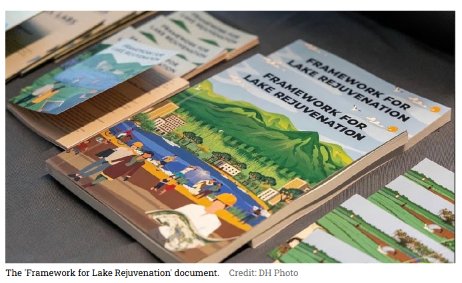
Stating that urban lake restoration cannot succeed through engineering interventions alone, WELL Labs on Sunday launched its ‘Framework for Lake Rejuvenation’, a science-based, community-led roadmap to guide the restoration of Bengaluru’s lakes.
The framework proposes a structured five-stage approach covering diagnosis and visioning, design, implementation, operation and maintenance, and monitoring and evaluation.
It has been developed in collaboration with Friends of Lakes and a coalition of research institutions, civil society organisations, government agencies and citizen groups.
Describing lake rejuvenation as a process that must balance scientific feasibility with community aspirations, WELL Labs Executive Director Veena Srinivasan said the framework is intended to foster consensus rather than conflict during decision-making.
A key recommendation is that every rejuvenation project should begin by identifying a lake’s primary purpose — whether flood mitigation, groundwater recharge, indirect potable reuse, ecological restoration or recreation — before deciding on interventions. The authors say this will ensure that each lake is restored according to its unique ecological and social context.
The launch was followed by a panel discussion featuring experts from research, policy, corporate social responsibility (CSR), urban planning and environmental practice.
The panellists stressed that scientific assessment should not end with project execution.
Aparna Unni of CDD, a non-profit, said monitoring metrics should be determined during the visioning stage itself and highlighted the shortage of implementation agencies that understand the ecological objectives of lake restoration projects.
The experts also cautioned against evaluating lake restoration using a single indicator, such as water storage capacity, arguing instead for a combination of hydrological, water quality and ecological parameters.
The framework builds on an earlier version and is intended to remain a living document, incorporating lessons from ongoing field projects. While the current edition covers diagnosis, design, and monitoring and evaluation, sections on implementation and long-term maintenance will be expanded as more projects are completed.
Article Credit: deccanherald