
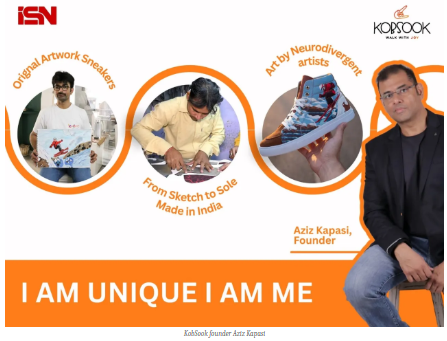
In the middle of Hauz Khas Village, KobSook brings to life the creative worlds perceived by neurodivergent artists, one canvas sneaker at a time.
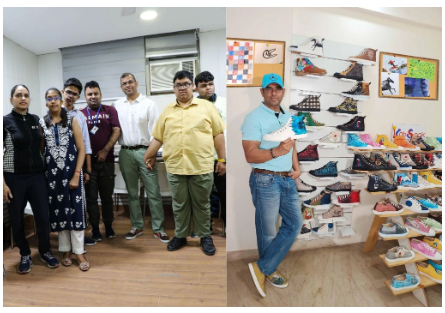
One section of their headquarters displays the brand’s limited-edition sneaker collections where visitors can see the original artwork up close. The other is where the business runs: artists at workstations, orders being processed, inventory tracked, content being shot.
The sneakers are assembled by hand at an in-house manufacturing facility, fabric printed, cut, stitched, with no conveyor belts or automated lines pushing volume. A deliberate process that makes sure original artwork gets the platform it deserves in a cluttered industry where all other brands are offering a similar product.
This is the operating rhythm of KobSook, a Delhi-based footwear startup founded in 2023.
In a category dominated by mass manufacturing and visual sameness, the company has chosen a more constrained model: limited-edition canvas sneakers, handcrafted in India, with designs created by differently-abled artists.
Founder Aziz Kapasi told ISN that the business did not begin with an ambition to scale quickly or chase fashion cycles. It began with a practical question: how to create steady, paid work for creatively skilled young adults often excluded from formal employment, and whether that work could be embedded into a consumer product built on commercial fundamentals rather than goodwill.
“The entire purpose for KobSook was to give meaningful and sustainable employment opportunities to the differently abled young adults,” Aziz says.
The idea behind KobSook
The name KobSook comes from Buddhism, where it refers to a person with a happy heart and compassion. For Kapasi, the word became a reference point rather than a slogan.
From the very beginning, the intent was to build a footwear brand that could support differently-abled young adults through sustained employment, not short-term projects or symbolic collaborations.
Before launching KobSook in 2023, Aziz identified several gaps in India’s canvas sneaker market. There were few homegrown brands offering premium-quality canvas sneakers made entirely in India. Design choices across the category were limited, repetitive, and often derivative.Most products looked similar, with little room for personal expression.
“There was no connect, no substantial contribution towards society,” he explained, adding that most offerings failed to reflect individual personality. “They all look the same, an imitation.”
At the same time, very few brands had any meaningful connection to social participation beyond surface-level messaging.
KobSook was positioned at the intersection of these gaps. The idea was to create artist-designed sneakers that reflect individuality, while building a system where artists are active contributors to the business rather than external beneficiaries.
Artists at the centre of the process
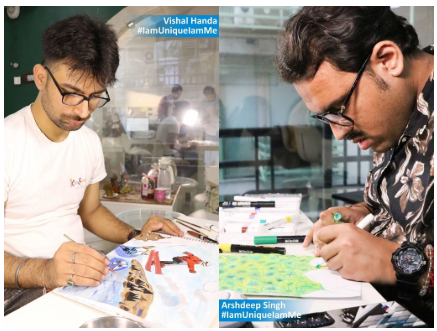
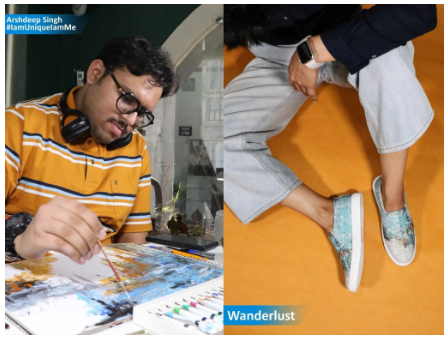
The operational core of KobSook rests on its engagement with differently-abled artists. The startup works with AIMS Media (Inclusive Accessible TechEd) as a training partner, which helps identify and prepare candidates through structured skill-development programmes.
Artists are trained in areas such as illustration, digital design, photo and video editing, and tools like Photoshop.
KobSook follows a defined onboarding process. Candidates are identified through AIMS Media, their skills are assessed, conversations are held with parents or guardians, and internships are offered before longer-term engagement.
Once onboarded, artists work as salaried team members. Their names are displayed alongside their designs on the KobSook website, a decision Kapasi believes is important for recognition and professional legitimacy.
“The mission is to empower differently-abled youth by giving them a platform where they are at the forefront, be it designing or operations,” he says.
Rather than being assigned generic tasks, artists are given creative ownership.
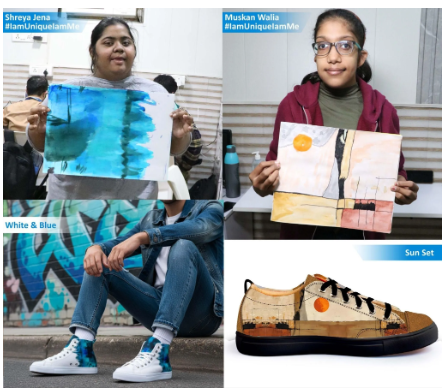
They work with themes inspired by nature, culture, abstract ideas, or everyday observations. Some artists prefer traditional hand drawing and painting, while others work entirely in digital formats. Hand-painted works are converted into digital files using high-resolution scanning, preserving original textures while enabling production. This approach allows artists to remain central to the product, while giving the brand a repeatable workflow.
From artwork to finished sneaker
Once an artwork is finalised, it enters a structured production pipeline. Each sneaker style has a digital pattern, a template that maps where different sections of the upper will be cut and stitched. The artwork is adapted to this pattern to ensure continuity and balance across the shoe.
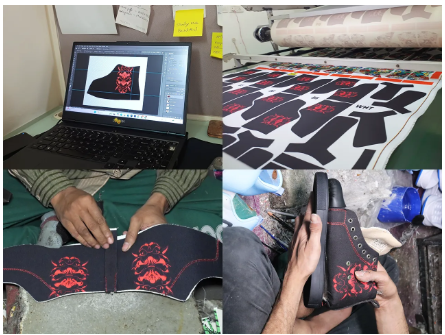
The designs are digitally printed onto selected canvas fabric. Fabric selection is handled carefully, with an emphasis on durability, comfort, and breathability. The printed canvas is then cut and stitched by hand. All sneakers are produced in limited quantities, reinforcing the brand’s decision to avoid mass replication.
Each pair is assembled manually and checked before packaging. Finished sneakers are packed in biodegradable shoe pouches, accompanied by a card that explains the KobSook process and the intent behind the brand. The packaging reflects the company’s emphasis on sustainability and restraint.
Because the process is labour-intensive, KobSook produces limited inventory per design. This limits volume but allows the brand to maintain consistency and control over quality.
Manufacturing in India, without automation
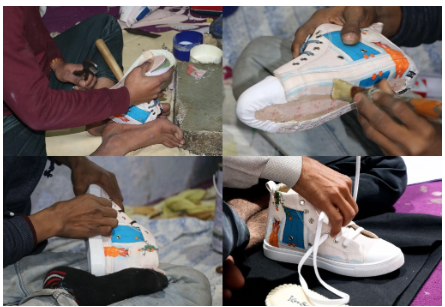
Every component of a KobSook sneaker from the sole to the canvas fabric to the thread that binds it together is sourced from within India. This was a deliberate choice, not an operational shortcut.
Building a fully indigenous supply chain without automated factories presented challenges. Identifying dependable vendors, ensuring consistent material quality, and maintaining timelines required extended trial and error.
According to Aziz , these difficulties shaped the brand’s identity rather than slowing it down.
Artisans involved in production are trained in-house. Training is treated as an ongoing process rather than a one-time intervention. With each production batch, the team works on improving precision, reducing waste, and optimising material usage.
Digital printing plays a critical role in scalability. While production remains manual, digital printing ensures colour consistency and detail accuracy across batches, even as designs vary.
Material choices are practical rather than experimental.
KobSook uses breathable and easy to clean canvas. The sneakers feature TPR (thermoplastic rubber) soles, chosen for their durability, light weight, and suitability for daily wear. Flat soles help distribute body weight evenly, while first-grade EVA insoles provide cushioning. The digital printing process is designed to prevent colour fading even after multiple washes.
Competing in a crowded sneaker market
Canvas sneakers are one of the most competitive segments in Indian footwear, dominated by large brands and fast-fashion players with scale advantages.
KobSook does not compete on volume or speed. Instead, its differentiation rests on three factors: original artwork, limited production, and a clear employment model tied to creative output. Each sneaker is positioned as wearable art rather than seasonal fashion. Customisation is an extension of this approach.
Customers often request personalised designs, including artwork inspired by comic characters, music, travel, sports, or personal interests. Each customised order follows the same process as standard designs, from concept development to digital layout to hand assembly. Delivery timelines for customised pairs are typically around 25 days.
Despite the handcrafted process, KobSook has aimed to keep pricing accessible. Sneakers are priced between Rs 1,700 and Rs 2,500.
Distribution, discipline, and growth plans
KobSook currently sells through its own website and across major ecommerce platforms including Myntra, Amazon, Ajio, and Flipkart.
The startup is entirely bootstrapped. Financial discipline has shaped most decisions, from hiring to marketing. The team remains small, with members handling multiple roles. Product development is treated as a continuous process rather than a fixed roadmap.
Marketing budgets exist, but the focus remains on organic growth.
Kapasi said the emphasis is on building a community rather than driving short-term sales, relying on repeat customers and word-of-mouth rather than heavy advertising.
“Our goal is to earn customer trust, and generate sustainable profits and not chase the valuation game.” Aziz says, without disclosing current revenue figures.
KobSook has set this long-term revenue target but says growth is being pursued cautiously, with an emphasis on sustainability rather than rapid expansion.
Building around participation
As Aziz indicates, KobSook is less focused on rapid expansion and more on building a system that can sustain creative work and employment over time.
While the startup operates as a consumer footwear brand, it has structured its operations so that production, employment, and inclusion are closely linked rather than treated as separate objectives.
By converting original artwork into wearable products, it aims to create stable income opportunities for differently abled artists while allowing their work to reach a wider audience.
“Our vision is to build a purpose-driven brand that seamlessly blends creativity, sustainability, and social inclusivity,” he says.
In addition to this, the startup aims to create what it describes as an ecosystem, where differently abled artists are recognised as professionals, their work is visible to consumers, and their contribution results in long-term livelihood rather than short-term engagement.
“By transforming their original creations into signature sneakers, we aim to provide a platform where their artistry is not only seen and valued, but also becomes a sustainable source of income and pride,” Aziz adds.
Article Credit: indianstartupnews