
A WOMAN labourer who sustains her family by working in the coal mine’s black, polluted water, her face marked by exhaustion and her body covered in sores and rashes caused by prolonged exposure to contaminated water, says: ‘We have been working in this dirty water for 20–25 years. We are extremely poor. We cannot make ends meet. Our children cannot continue their education. One person’s income is not enough to run a family.’
Mansura Akter, a domestic worker who returns home at midnight after working in three households, says as she prepares to light her cooking stove: ‘My husband is a driver. I used to feel ashamed of working in other people’s homes as a driver’s wife. But now, Tk 25,000–30,000 is not enough to run a household. My daughter is often ill and there are my son’s educational expenses. I had to start working to keep up.’
Meanwhile, microfinance institutions largely conceptualise women’s empowerment in terms of increased financial participation, mobility and household decision-making. Yet, in the patriarchal social structure of rural Bangladesh, men continue to control and use most of the loans taken out in women’s names. While MFIs present high loan recovery rates as evidence of women’s empowerment, they do little to address this underlying reality. Instead, they exploit women’s structural vulnerabilities — including the gendered division of labour, restrictions on mobility and social notions of honour and shame — to ensure loan recovery.
Mr Ahamed, a loan management officer with 26 years of experience, offers a revealing observation: ‘Previously, if you asked rural men what assets they had, they would mention a cow, a son, a house or a piece of land. But nowadays, they consider women an asset because of their participation in microfinance. Women bring money home through microfinance participation.’
Three incidents, taken together, confront us with the socio-economic reality of Bangladesh. Many women are compelled to leave their homes and enter the workforce in pursuit of economic and social emancipation. It is against this backdrop that a minister of state chose to offer his personal opinion at a press conference. State minister Mir Shahe Alam believes that women’s employment is detrimental to family life and if women devoted more time to their families, their children could grow up to become engineers and doctors.
His remark couldn’t be further from the reality most women find themselves in. Women continue to toil for hours in the black waters of coal mines, struggling to secure a future for their children. Even then, their children can barely afford to dream of becoming engineers or doctors. Working-class mothers, however, dare to dream on their children’s behalf. They break through the chains of patriarchy, negotiate its countless conditions and compromises and enter the workforce. Even there, they are subjected to exploitation and abuse. Meanwhile, those who came to power invoking the rhetoric of women’s empowerment continue to demean working women through their supposedly ‘personal’ opinions.
Just before the 2026 national election, Jamaat-e-Islami had launched a similar campaign against working women. In response, working-class and employed women took to the streets of Mirpur in a protest march carrying brooms, while social media erupted in protest. At the time, BNP leaders had strongly condemned Jamaat-e-Islami’s ameer Dr Shafiqur Rahman’s remarks, seeking to win the confidence and votes of women voters. Yet, after winning the election and forming the government, it is now a BNP minister of state who is echoing the same sentiment.The minister’s position is fundamentally at odds with the BNP’s own commitment to women’s empowerment, as outlined in its 31-point reform agenda and election manifesto.
Minister’s remark vs BNP’s own commitments
THE BNP’s manifesto for the 13th parliamentary election in 2026, its foundational document, 31 Points for Reforming the State Structure, and its Vision 2030 all contain specific commitments to women’s empowerment. Under Point 28 of the 31-point agenda, the party pledged to introduce a ‘Family Card’ in the name of the mother or female head of each household, with the stated aim of strengthening women’s financial security and decision-making power.
The point 27 of the party’s reform agenda and its election manifesto promise to establish childcare or day-care centres in public and private offices and industrial zones to prevent working mothers from dropping out of the workforce. They also pledge equal pay for equal work. Other commitments include a one-year unemployment allowance for educated young men and women, low-interest SME loans for women entrepreneurs and training in information technology and freelancing. Similarly, Point 25 promises to extend free education and stipends for girls up to the undergraduate level and provide special scholarships for female students in STEM.
If the party’s manifesto promises day-care centres to help mothers remain in the workforce, then the minister’s advice that women should stay at home directly calls into question the government’s own programme. One might even argue that progressive promises are useful when seeking electoral victory, but once in power, personal prejudices begin to shape political thinking and policy. If our policymakers genuinely hold such views, they should be a cause for alarm for women across Bangladesh. The post from the Jamaat-e-Islami ameer’s X account that sexualised and stigmatised working women, alongside statements from ruling-party leaders, now appears to be singing from the same hymn sheet.
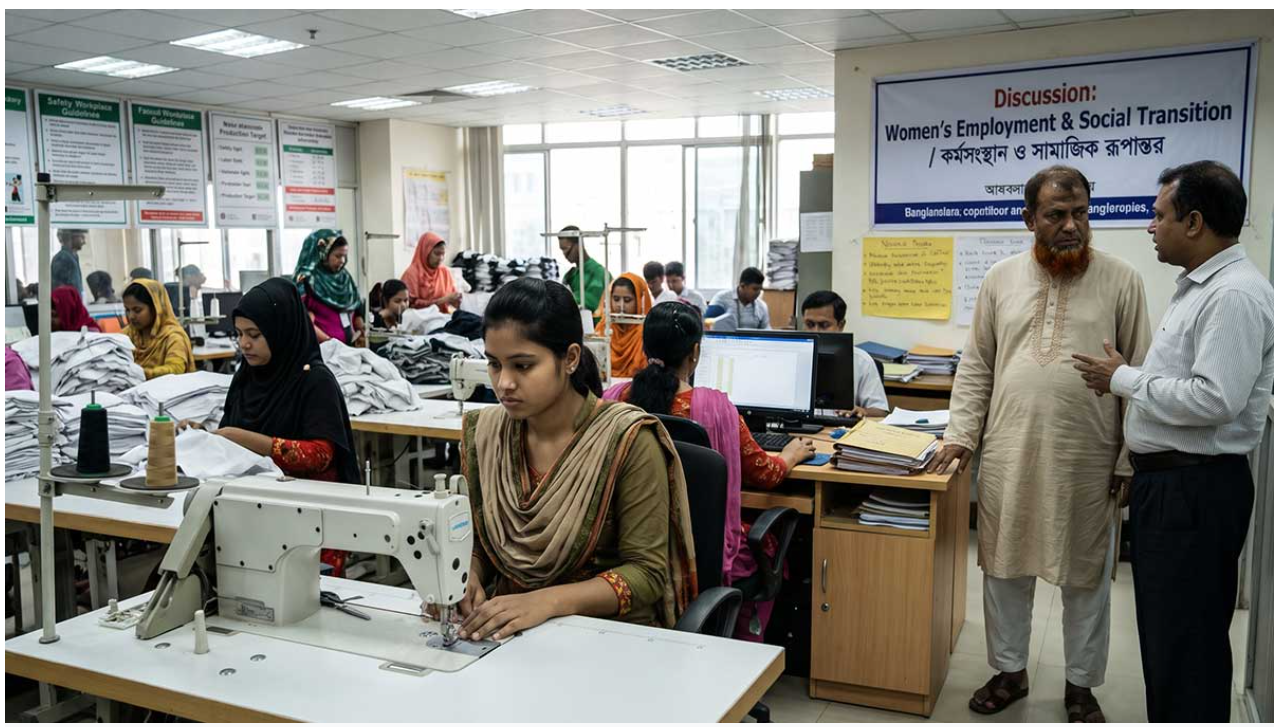
The garment industry is one of the country’s major sources of revenue. It is women workers who keep this industry running. Many of these women may once have worked in agriculture in their rural communities, their saris tucked up as they laboured in the fields. After facing repeated losses and uncertainties in agriculture, increasing numbers of rural women and men have moved into the garment industry. Yet exploitation follows them there, too. If workers were to abandon factories according to a minister’s opinion that helps produce and sustain a cheap labour force, would that minister take responsibility for feeding and raising their children?
Ensuring a child’s healthy development is the responsibility of the state. But the government prefers to see the people it calls its ‘human resources’ merely as workers. So, while Zaima Rahman speaks of women’s empowerment and helps bring women’s votes to the BNP, Mir Shahe Alams occupying positions of power expose the narrowness of the party’s outlook through their supposedly personal opinions.
Women’s economic freedom
IN HER work The Social Basis of the Woman Question, Marxist revolutionary Alexandra Kollontai examines how property relations and economic dependence restrict women’s independent existence. Women from wealthy families may enjoy a socially ‘respectable’ life while remaining economically dependent on their husbands. Their autonomy and freedom are constrained by the boundaries of conservatism, imposed in the name of preserving their respectable social standing.
Working-class women, on the other hand, are breaking through these boundaries. Driven by the necessity of survival, they are entering the world of production and wage labour. In doing so, they are carving out a path towards economic independence while constantly negotiating and confronting the conditions and forms of oppression imposed by a patriarchal society. Their entry into the workforce is not merely about contributing to household income; it is also a challenge to the existing structures of patriarchal power.
The problem is that instead of recognising this economic independence, those who govern and shape political discourse seek to push women back into their homes —sometimes in the name of religious morality, sometimes in the name of family values and sometimes under the pretext of securing their children’s future. Yet the very state that fails to guarantee children safe education, healthcare and an environment in which they can grow up with dignity discourages women from entering formal workforce.
From the Jamaat-e-Islami ameer’s remarks to the opinions expressed by current state minister, political differences notwithstanding, their discomfort with working women’s autonomy appears remarkably similar.
It is as though women’s labour is welcome, but not their freedom; their income is necessary, but not their control over it.
The state has no objection to women being workers. Their objection begins when working women demand control over their own lives, labour and earnings.
SLSV Insights
- From access to agency: International best practice now measures not just jobs, but control over income, mobility, and time. The article shows loans in women’s names still controlled by men, proving access without agency reproduces patriarchy.
- Care as infrastructure: OECD, ILO and Nordic models treat universal childcare, paid parental leave, and flexible work as economic infrastructure, not welfare, to reduce the motherhood penalty.
- Safe work, safe mobility: Emerging standards under ILO Convention 190 link harassment-free workplaces, safe transport, and night-shift protections to women’s retention.
- Digital and green transitions: Future trends prioritise STEM, AI literacy, and green jobs for women to prevent a new gender divide in high-growth sectors.
- Engaging men and norms: Paternity leave, shared care, and school-based norm change are now central to shifting patriarchal anxiety.
- Data and accountability: Pay-transparency laws, gender audits, and time-use data are becoming global benchmarks for enforcement. 3fae
SLSV recommends: Bangladesh needs to move beyond counting women workers to guaranteeing care, safety, income control, and digital skills — so employment becomes empowerment, not mere survival under patriarchal control.
Article Credit: newagebd, SLSVoriginal source/SLSV