
UK, US, Japan and Denmark test eco-friendly renewable energy storage systems using liquid air, molten salt and sweat-powered wearables
From smartphones and laptops to electric vehicles and energy storage systems (ESS), a wide range of technologies are being tested around the world as alternatives for storing energy in place of lithium-ion batteries. The strategy is to move beyond lithium-ion batteries, which have drawbacks in performance and safety and come at a high cost, to secure technologies that can store electrical energy and to actively implement energy storage systems (ESS) that make more efficient use of eco-friendly renewable energy.
According to major foreign media outlets on the 23rd, demonstration projects for new energy storage technologies are taking shape in countries such as the United Kingdom, the United States and Japan. These projects are exploring whether various energy storage technologies, ranging from molten salt—made by melting common salt—through to human sweat, can be put to practical use.
Lithium-ion batteries have the drawback that their lifespan decreases as they go through repeated charge and discharge cycles. Because they use flammable liquid electrolytes, they are also prone to “thermal runaway”: a rapid rise in internal battery temperature that can occur under conditions such as overcharging, external impact or manufacturing defects. Another limitation is that they are difficult to recycle. Although lithium can be recovered from end-of-life lithium-ion batteries, the process is complex and costly, and it increases environmental burdens. Large amounts of water are used in lithium mining, and ecosystems can be damaged.
• Storing electricity by freezing air into liquid air
On the site of a former coal-fired power plant in Carrington village, in Trafford, Manchester, UK, a green cluster is being built to nurture the “Carrington Liquid Air Cryobattery” industry.
As the name suggests, a cryobattery is a system that stores electrical energy using cryogenic (ultra-low temperature) technology. First, surplus electricity from renewable sources produced in Carrington, such as wind and solar power, is used to cool air down to -196 °C, compressing its volume to one-seven-hundredth and turning it into liquid air. The liquid air is stored in tanks. When electricity is needed, the temperature of the liquid air is raised so that it expands into a gas, and the expanding air drives a turbine to generate electricity. In theory, a cryobattery can store energy for up to several weeks.
The cryobattery is scheduled to start operating at the end of this year. Once the air is stored, it is expected to be able to supply 50 MW (megawatts) of power continuously for six hours. That is enough electricity for up to 500,000 households to use at the same time.
• Melting salt to drive decarbonization
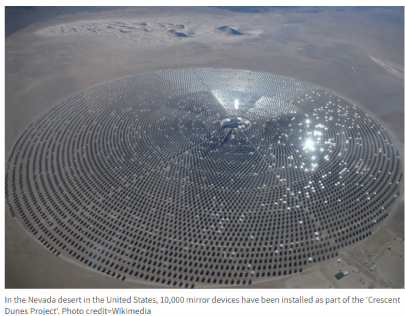
Projects that generate electrical energy using molten salt—salt melted into a liquid state—are also underway in the United States and Denmark. The “Crescent Dunes Project,” being carried out near Tonopah in Nevada, USA, is a project that produces electricity using 10,000 heliostats (mirror devices).
Heliostats track the sun and reflect sunlight onto a central power tower. At this point, a storage tank containing a mixture of sodium nitrate and potassium nitrate absorbs concentrated sunlight and is heated to 565 °C, forming molten salt. Molten salt is a substance produced by heating solid salt so that it melts into a liquid state.
The heated molten salt can be stored for up to 10 hours even after sunset. When electricity is needed, the stored molten salt circulates inside a generator to boil water and produce high-temperature steam. The steam turns a turbine to generate electricity, and the molten salt, having lost its heat, moves to a low-temperature storage tank.
Denmark, a leading country in wind power generation, announced earlier this year a molten salt battery project with a capacity of 1 GWh (gigawatt-hours) that heats salt to about 600 °C and can store electricity for up to two weeks. Denmark sees molten salt batteries as a solution for achieving decarbonization in heavy industry.
• Using sweat to power wearable devices
Tokyo University of Science in Japan is researching ways to use human sweat as an energy source to power wearable devices. Because this approach eliminates the need to incorporate bulky batteries into wearable devices, it can make them lighter.
The research team has developed a thin, patch-type wearable device that generates electricity directly from human sweat. This device uses an “enzyme-based biofuel cell (EBFC),” which employs enzymes as catalysts to capture chemicals released in sweat and convert them into electrical power. When sweat comes into contact with the patch, the embedded enzymes trigger a biochemical reaction that releases electrons. Once sweat batteries are commercialized, it is expected that wearable devices will be able to operate without external power sources while people walk, exercise and go about daily activities.
Additionally, in the village of Pornainen in southern Finland, thousands of tons of sand are being used to supply heating to schools, libraries and city halls. Soapstone—a rock used for decorative items and other purposes—is crushed into a sand-like material, which stores heat and then releases it when needed for district heating and hot water supply. It is reported that using 2,000 t (tons) of soapstone can provide 1 MW of thermal output and an energy storage capacity of 100 MWh (megawatt-hours).
Article Credit: dongascience