
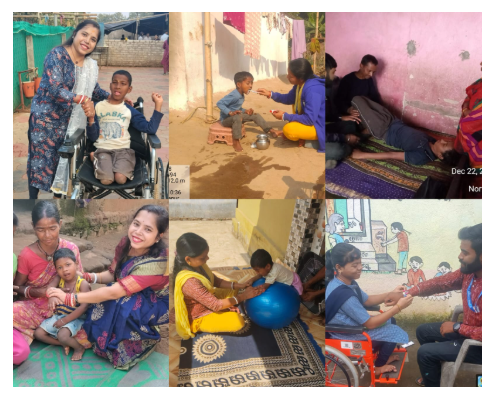
By Lopamudra Pradhan: While many medical professionals seek lucrative careers in metropolitan cities, a dedicated mental health professional and doctor is spearheading a silent revolution in the remote, tribal-dominated terrains of Odisha.
Armed with a doctorate in Psychology specializing in Autism Spectrum Disorder and Child Rights, Dr.Sarita Balaji is on a mission to empower Persons with Disabilities (PwDs) and eradicate deep-rooted superstitions surrounding mental health.
Associated with the organization ‘Sadbhavana’ and working as a State Consultant for Disability, she has been working relentlessly since 2015 in districts like Koraput, Mayurbhanj, Kalahandi, Malkangiri, and Keonjhar.
Prior to her work in Odisha, she began her journey in the rural belts of Himachal Pradesh and Uttarakhand in 2005.
Tragedy and Friendship: The Roots of Inspiration– Dr.Sarita’s calling to serve the marginalized stems from deeply personal experiences.
Born in Koraput, her greatest childhood inspiration was her best friend a disabled girl who, despite a lack of resources, showcased immense potential.
Battling Geographical Hurdles and Deep-Rooted Superstitions– Working in the tribal lands is no easy feat.
She faces severe geographical challenges, including navigating dense forests with no roads, lack of electricity, poor digital connectivity, harsh monsoon seasons that cut off jungle paths, and the constant threat of wild animal rampages.
In places like the dense, hilly terrains of Odisha’s Keonjhar district, modern healthcare often stops where the paved roads end, leaving the differently-abled populations of the indigenous Juang, Munda, and Bhuyan tribes isolated in the shadows of the jungle.
However, the biggest hurdle she faces is not geographical, but psychological.
In many tribal hamlets, a physical or intellectual disability is still viewed as an insurmountable fate, a “curse,” or the result of “past life sins.” “There are extreme superstitions,” she explained during the interview.
“For instance, villagers believe that epileptic fits or seizures are controlled by the moon’s position.
Sometimes, disabled individuals are subjected to physical abuse, tying up, or burning under the guise of traditional healing.” To combat this, she employs grassroots psycho-education.
By living among the villagers, sharing their food, and respecting their culture, she builds vital trust.
For those who cannot read, she uses pictorials, flashcards, and videos to explain the scientific and medical realities of disabilities, effectively dismantling myths with the help of village heads.
Breaking Barriers: The Sadbhavana Strategy– To overcome the fact that the primary barrier isn’t just the disability, but the sheer distance to the nearest clinic, Dr.
Sarita and the Sadbhavana Special School and Rehabilitation Center have turned Community-Based Rehabilitation (CBR) from a theory into a lifeline.
Their success in system strengthening lies in a three-pillar approach: 1.Field Interventions & Home-Based Care: Rather than waiting for patients to arrive at the center, Sadbhavana’s mobile teams penetrate deep-forest settlements.
They provide doorstep physiotherapy, speech therapy, and special education, ensuring that even those in the most inaccessible hamlets receive professional care.
2.Resourceful Innovation: In a masterclass of ecosystem-based innovation, the center trains locals to build low-cost assistive devices using indigenous materials like bamboo, coconut rope, and recycled tires.
Parallel bars for walking and balance equipment are now part of tribal households, built by the community for the community.
3.Training & Empowering Local Leads: By training local women and Self-Help Group (SHG) leaders on disability rights and care, Sadbhavana has created a sustainable “human infrastructure.” This turns the neighbors and family members of the differently-abled into their primary advocates and caregivers.
Triumphs of the Human Spirit These grassroots interventions, focusing heavily on social inclusion and vocational training, are yielding remarkable results.
Through community-based rehabilitation programs, many disabled individuals are now becoming self-reliant.
She recalls a particularly moving success story during the COVID-19 pandemic.
A severely disabled girl in a remote village, supported by the ‘Sadbhavana’ organization, refused to be defeated by the lockdown.
She set up a small workspace in front of her hut, making masks and providing food.
Today, that girl is a successful and independent entrepreneur.
Furthermore, the doctor proudly notes that PwDs from these remote regions are now breaking international barriers, participating, and winning medals in National and International Special Olympics.
Her team has also made significant strides in educating disabled girls and their families about menstrual hygiene, a topic that was previously a strict taboo.
A Message to the Youth– When asked about her message to the younger generation, she emphasized the power of empathy and service.
“Do not let the darkness deter you; if you have the spirit of service, even a single step can act as a lamp to dispel the dark,” she urged.
“Look beyond personal success.
If we can hold the hands of those who are struggling, we validate our own humanity.
That is the true essence of education and success.” Today, Dr.Sarita Balaji’s journey stands as a powerful testament to how education, empathy, and sheer willpower can transform the lives of the most vulnerable and marginalized populations in the country.
She and her team are not just rehabilitating individuals; they are restoring their dignity within the tribal fabric, proving that true progress is measured by how well a society supports its most vulnerable members no matter how deep in the forest they may live.
Article Credit: odisharay