
The November 18 guidelines replace the March 2024 norms and cover conditions ranging from locomotor and visual disabilities to autism, mental illness and chronic neurological disorders
The Centre has notified revised guidelines for assessing eight categories of specified disabilities under the Rights of Persons with Disabilities Act, 2016, replacing the norms issued in March 2024.
The guidelines, issued by the Department of Empowerment of Persons with Disabilities on November 18, cover locomotor disability, visual impairment, hearing impairment and speech and language disability, specific learning disability, intellectual disability and autism spectrum disorder, mental illness, blood disorder, multiple disorder and chronic neurological disorder.
For locomotor disabilities, assessment of the upper extremities covers the arm and hand, including range of motion, muscle strength, coordinated activities, prehension and sensation.
Conditions covered include amputation, cerebral palsy, leprosy-cured persons, dwarfism, muscular dystrophy and spinal deformities.
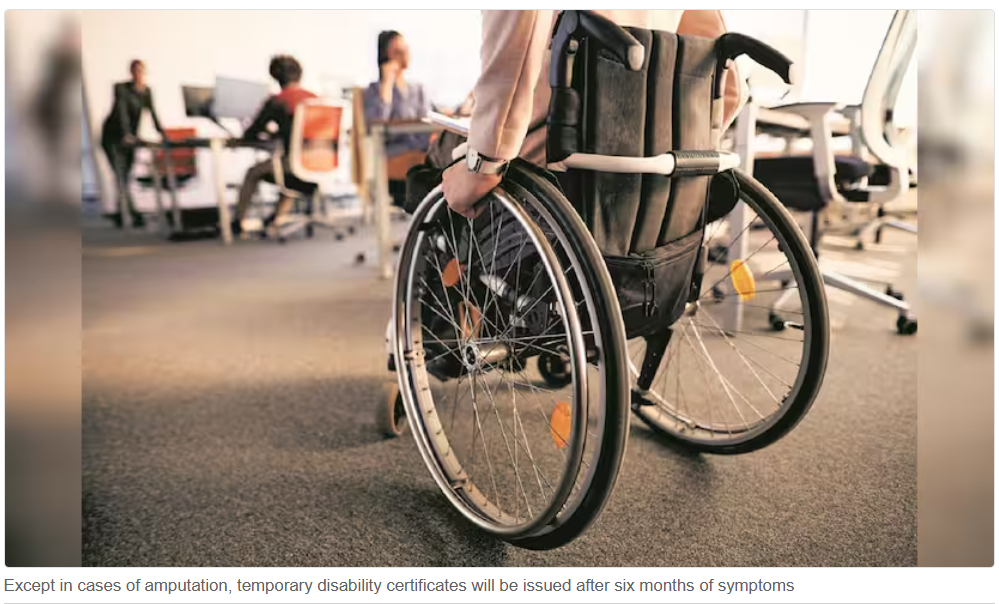
Except in cases of amputation, temporary disability certificates will be issued after six months of symptoms. Permanent certificates will be issued after the age of 18, with reassessment every 10 years where requested by the person with disability or recommended by a subject expert.
Dwarfism is defined as an adult height of less than 147 cm (4 feet 8 inches). Every one-inch reduction in vertical height attracts four per cent permanent physical impairment, while associated skeletal deformities are assessed separately.
Blindness includes total absence of sight, visual acuity (measure of how clearly eyes can see) below 3/60 in the better eye after best possible correction, or a field of vision of less than 10 degrees. Low vision covers visual acuity below 6/18 up to 3/60, or a field of vision below 40 degrees up to 10 degrees.
Hearing impairment is assessed through Pure Tone Audiometry, with hearing thresholds measured at 500, 1,000, 2,000 and 4,000 Hz. Speech and language disability assessment covers conditions such as laryngectomy, glossectomy, bilateral vocal cord paralysis, dysarthria and apraxia of speech.
The latter two are assessed after one year of regular documented speech therapy by registered speech-language pathologists.
For intellectual disability, assessment considers intellectual functioning and adaptive behaviour. The disability percentage is 25 per cent for borderline, 50 per cent for mild, 75 per cent for moderate, 90 per cent for severe and 100 per cent for profound intellectual disability.
The minimum age for certification is one completed year. Children above one year and up to five years will be diagnosed with Global Developmental Delay, while those above five years will be assessed for intellectual disability.
Specific learning disability covers difficulties in reading, written expression and mathematics. These must persist for at least six months despite targeted, evidence-based intervention. Assessment requires an IQ score of 85 or above.
The NIMHANS battery and NIEPID Grade Level Assessment Instrument for Schools are prescribed for children up to 18 years, while the NIEPID Adult Assessment Tool for Specific Learning Disability is prescribed for adults.
Autism spectrum disorder is diagnosed using the AIIMS-modified INCLEN tool. Children below six years will receive a diagnosis of moderate autism and a temporary certificate, with reassessment at six years or above.
For those aged six years and above, the disability percentage is 40 per cent for an Indian Scale for Assessment of Autism (ISAA) score of 70, 50 per cent for scores between 71 and 88, 60 per cent for 89-106, 70 per cent for 107-123, 80 per cent for 124-140, 90 per cent for 141-153 and 100 per cent for scores above 153. A score below 70 indicates no autism.
Mental illness is assessed through a psychiatrist’s clinical examination and the Indian Disability Evaluation and Assessment Scale, which covers self-care, interpersonal activities, communication and understanding, and work.
The disability percentage is 25 per cent for mild, 55 per cent for moderate, 85 per cent for severe and 100 per cent for profound disability.
A minimum illness duration of two years is required for permanent certification. For illness lasting less than two years, a time-valid certificate may be issued, though severe or profound cases may be considered for permanent certification.
The blood disorders covered are haemophilia, thalassemia and sickle cell disorders. A benchmark disability of 40 per cent is prescribed for patients meeting the criteria for severe haemophilia, thalassemia major or intermedia, transfusion-dependent thalassemia intermedia, homozygous sickle cell disease and severe compound heterozygous sickle cell syndromes, including sickle-beta thalassemia and sickle-HbD.
For haemophilia, the criteria include factor VIII or IX levels — clotting factors — below five per cent, along with a history of two or more bleeds in major joints, one intracranial bleed or one muscle bleed.
For multiple disabilities, two or more specified conditions are assessed individually. Only disabilities of at least 25 per cent are included in the composite calculation.
The prescribed formula combines the higher and lower disability percentages. For instance, 40 per cent hearing disability and 30 per cent visual disability result in a composite disability of 58 per cent. The combined percentage cannot exceed 100.
Chronic neurological disorders, including Parkinson’s disease and multiple sclerosis, are assessed across locomotor, visual, hearing, speech, cognitive and psychosocial impairments.
For epilepsy, the prescribed disability percentage is nil for a single convulsion (epileptic seizure episode), 25 per cent for one to five convulsions a month, 50 per cent for six to 10, and 75 per cent for more than 10 convulsions a month.
State governments and Union Territory administrations will designate persons with requisite qualifications and experience as certifying authorities for issuing disability certificates and Unique Disability Identity (UDID) cards.
The Director General of Health Services under the Health Ministry will decide cases involving doubts over interpretation of the definitions, classifications or evaluation procedures.
SLSV Analysis and Insights
- From impairment to functioning: The November 18 norms move India closer to the WHO ICF model, assessing what a person can do — range of motion, strength, prehension, sensation, adaptive behaviour — not only diagnosis.
- Standardisation reduces discretion: Fixed thresholds for dwarfism, vision, hearing, intellectual disability and autism mirror international best practice in the UK, Australia and Canada, where structured scales improve consistency and appealability.
- Early and periodic review matters: Temporary certificates after six months, permanent certificates after 18, and reassessment every 10 years reflect the global shift to life-course assessment, recognising that disability, recovery and assistive technology change over time.
- Emerging trend — digital and remote assessment: Future systems are moving to UDID-linked electronic records, tele-assessment for follow-ups, AI-assisted audiometry, vision screening and standardised scoring to cut delays and interstate variation.
- Future trend — participation-based outcomes: Leading frameworks now add education, work, mobility and community participation to percentage scores, so certification drives support, reasonable accommodation and inclusion rather than only benefits.
- Risk to watch: Without trained assessors, accessible test tools and grievance redress, standardised scales can still exclude people with fluctuating, invisible or multiple disabilities. e0b2a5b9
SLSV Recommends
- Adopt ICF-linked functional assessment, publish assessor training and test protocols, integrate certificates with UDID and digital health records, pilot tele-reassessment, and add participation and support-needs reporting alongside disability percentage.
Article Credit: business-standard, SLSVoriginal source/SLSV