
The Food Securities Fund (FSF) is an example of how targeted financial innovation can unlock financing for more sustainable and just agriculture.
Developed and implemented by Clarmondial with support from the Global Environment Facility (GEF) through Conservation International, this blended finance fund utilizes sustainable supply chain commitments to channel investment into agricultural supply chains in emerging and developing markets. Its offering of pre-harvest working capital enables businesses to integrate sustainability earlier and more deeply into their operations, helping improve smallholder farmer livelihoods as well as resilience to economic, weather, and natural disaster shocks.
Why is this important? Because in agriculture, timing is everything.
Without access to capital ahead of harvest, even the best climate-smart solutions can be out of reach. The lack of affordable, accessible capital during the pre-harvest period constrains the implementation of regenerative practices. The FSF has demonstrated an innovative, sustainable and scalable solution that addresses this pervasive gap.
With catalytic capital from the GEF’s Non-Grant Instrument program, and risk-sharing from agriculture companies, the FSF has become a model for blending public and private resources to generate measurable environmental and social outcomes. It is also an open-ended (evergreen) fund that delivers quarterly performance, connecting the needs of long-term institutional investors with those of agricultural supply chains.
The fund’s objectives go beyond financing. The Food Securities Fund is designed to accelerate biodiversity conservation, climate change mitigation, and land restoration, as well as improving rural livelihoods. Its portfolio spans Latin America to Sub-Saharan Africa, targeting businesses that actively engage with smallholders and prioritize traceable, sustainable sourcing.
This model is significant in the face of volatile markets, such as cocoa and coffee. With inconsistent prices, access to timely capital pre-harvest becomes even more important for building resilience and integrating business-material sustainably.
“Pre-harvest financing has proven essential in enabling resilient and impactful supply chains, including in the face of record commodity price volatility,” said Tanja Havemann, Director of the Food Securities Fund and Founder of Clarmondial. “Through these investments, we’re seeing benefits for smallholder farmers, their business partners, and local economies.”
Over its first four years, results have included:
- 150,962 hectares of land restored and 377,680 hectares under certified sustainable practices
- 215,939 tons of carbon dioxide equivalent sequestered
- 95,181 smallholder farmers engaged and 2,679 jobs supported.
By 2030, FSF aims to improve the management of at least 2.1 million hectares and benefit 700,000 people, also contributing to international environmental conventions on biodiversity, desertification, and climate change.
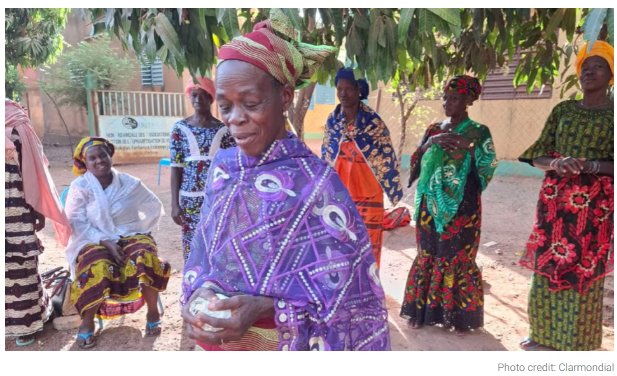
In Burkina Faso, for example, FSF’s financing has enabled gebana Burkina Faso to strengthen its fairtrade organic mango and cashew supply chains. Working with 4,500 farming families and employing more than 650 women, the company promotes agroforestry and pays revenue-based premiums. In 2024 alone, over $2.2 million was distributed directly to farmers, reinforcing the fund’s ability to deliver inclusive economic value.
“By strengthening farmers’ capacity through trainings on agroforestry, biofertilizer, biopesticide production, and composting, we directly contribute to biodiversity and environmental protection,” said Ousseni Porgo, CEO of gebana Burkina Faso. “Farmers have seen firsthand how these improved practices increase crop resilience and yields. Through our fairtrade premium and revenue-sharing program, 10% of our web shop turnover is transferred annually to gebana Burkina Faso and redistributed to farmers, engaging [them] directly in the business model.”
The concept behind FSF draws on decades of experience in agri-banking, impact investing, environmental sciences, and development finance. When Clarmondial recognized a gap in financing for “aggregators”, essential businesses that connect farmers to global markets, Conservation International and the GEF stepped up to support the initiative.
“This fund bridges the gap between small-scale farmers and the business support they need to transition to sustainable agriculture,” said Orissa Samaroo, Vice President of the CI-GEF Agency. “Its model enables both long-term productivity and resilience by making quality inputs, services, and training accessible at the right time, and with sustainably aligned business partners.”
All investors, except the GEF, are private institutions including a bank, a reinsurance company, family offices, and endowments. This group of investors reflects both the financial viability of the model and a growing appetite for investment vehicles that generate positive environmental and social outcomes.
Article Credit: thegef