
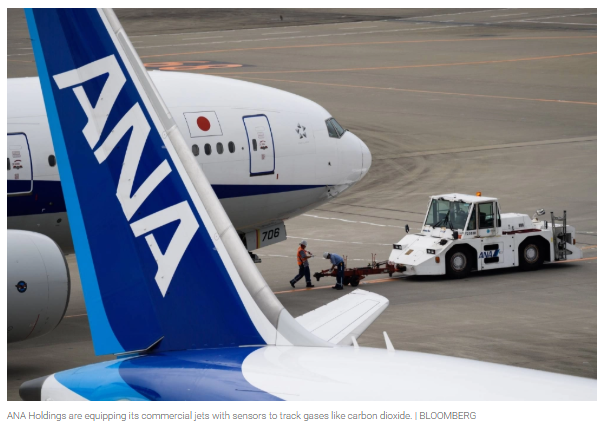
ANA Holdings, Japan’s largest airline, and the nation’s space agency are accelerating efforts to use sensors mounted on commercial jets to improve the monitoring of greenhouse gas emissions.
Equipment, which has been tested since 2020, is now in operation in a modified section of a regular Boeing 737 operated by ANA, according to a joint statement from the airline and the Japan Aerospace Exploration Agency (JAXA). It’s intended to track gases like carbon dioxide and offer more detailed measurements than some satellites.
ANA and JAXA plan to equip another domestic aircraft with a similar device, and the carrier is looking into ways to use the data to generate revenue.
The efforts reflect a wider push by companies and governments to close gaps in emissions monitoring as compliance demands rise, and to supplement tools like satellites to deliver a greater degree of precision or to extend coverage to more sources of pollution.
JAXA said the work with ANA will allow it to combine satellite observations with more detailed aircraft data and offer greater accuracy, particularly in urban areas.
It’s not the first time commercial aircraft have been used to collect atmospheric data. Deutsche Lufthansa added sensors on long-haul aircraft to measure ozone and water vapor. In the United States, United Airlines Holdings, and the National Oceanic and Atmospheric Administration have partnered on tracking emissions and improving weather forecasts.
Article Credit: japantimes