
As sustainability moves to the centre of coffee production strategy, roasting technology is emerging as a critical lever for reducing energy use, improving efficiency, and maintaining quality at scale.
Whether it’s a boutique micro-roastery or multinational producer, sustainability is no longer a peripheral consideration in coffee production. Instead, it’s increasingly shaping decisions around equipment investment, process design, and long-term business strategy.
Within this evolving landscape, IMA Coffee Hub is positioning technology and digitalisation as key enablers of more responsible coffee processing. With integrated solutions for coffee roasting and packaging, the company is helping roasters reduce their energy consumption and waste without compromising quality – a balance that has become central to modern coffee operations.
Nicola Panzani, CEO of IMA Petroncini and Commercial Director of IMA Coffee Hub, has observed a shift across the industry. He notes that while sustainability is now a shared priority, its implementation looks different depending on scale. Larger producers tend to invest in infrastructure upgrades and system-wide solutions, while independent roasters often adopt more flexible, locally focused approaches.
“In today’s landscape, quality, sustainability, and traceability have become essential elements in coffee production – especially in large-scale operations,” says Nicola.
“There’s a clear shift towards reducing energy waste, selecting environmentally friendly packaging materials, and maintaining high-quality standards throughout every phase of production.”
According to Nicola, digitalisation plays a critical role in enabling this shift. Real-time data collection and analysis are transforming how producers manage their operations, providing deeper visibility across the entire value chain – from green coffee intake through to roasting and packaging.
“With data-driven technologies, producers can fine-tune efficiency, limit their environmental footprint, and scale sustainably,” she says.
“At IMA Coffee Hub, we strive to support producers of every size in implementing these strategies, offering innovative and eco-conscious technological solutions. Digital transformation is not just a trend – it’s becoming the backbone of modern coffee production.”
Despite the progress, embedding sustainability at scale remains complex. Nicola notes how large roasters must integrate new technologies into existing workflows, manage natural resources more efficiently, and respond to increasing consumer expectations around environmental responsibility. All while maintaining economic viability.
“Aside from technological investments, companies need to adopt a long-term commitment to sustainable supply chain management and ongoing process optimisation. Striking a balance between profitability and environmental responsibility is now a strategic priority,” he says.
Roasting remains one of the most energy-intensive stages of coffee production, making it a key focus for innovation. As regulations tighten and energy costs fluctuate, roasters are increasingly investing in heat recovery systems and advanced exhaust gas treatment technologies to reduce consumption and CO₂ emissions.
In response, IMA Coffee Hub has developed a range of solutions aimed at improving energy efficiency across different production scales. One of its major projects is a modular hybrid roasting system designed for industrial operations. By combining traditional gas burners with a secondary electrical heating source, the system allows greater flexibility and customisation.
“This solution enables our customers to better calibrate their processes to reduce energy consumption while also cutting operational costs and CO₂ output,” Nicola explains. “By combining different energy sources, we can fine-tune the roasting profile and ensure both efficiency and quality.”
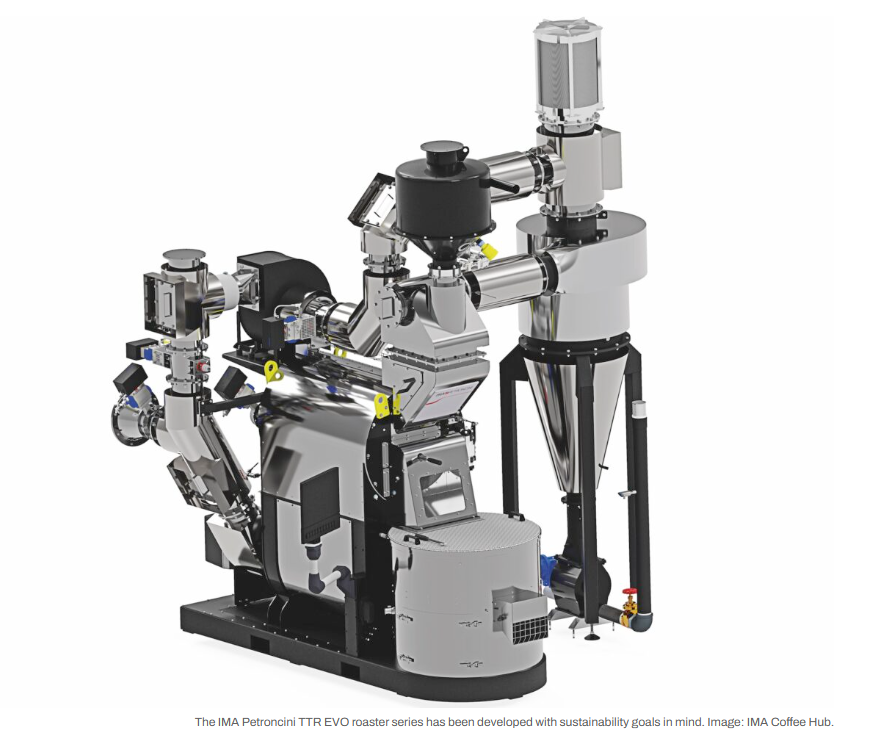
For smaller operations, IMA has focused on maximising the effectiveness of heat recovery through the design of its Petroncini TTR EVO roasters. Using thermodynamic optimisation, these machines are engineered to reclaim and reuse heat more efficiently, delivering measurable reductions in energy use even at lower volumes.
The company says TTR EVO range is designed with durability, safety, and environmental performance in mind. Low-impact, recyclable materials are prioritised, while the roaster’s structure allows for targeted maintenance, reducing the need for replacements and limiting long-term resource consumption.
“Special attention has been given to energy efficiency: optimised thermal flows and improved insulation systems significantly reduce energy consumption during the roasting process, without compromising the quality of the final result,” Nicola says.
“By minimising heat loss and optimising combustion efficiency, the TTR EVO achieves substantial energy savings and a reduction in CO₂ emissions.
“This systemic approach to sustainability enables the TTR EVO to meet the needs of a modern, responsible roasting facility, fully aligned with circular-economy principles and environmental accountability.”
Digital control is another pillar of the system. Integrated sensors and monitoring tools enable precise control of roasting parameters, supporting data-driven optimisation. The TTR EVO is paired with VIRTUO supervision software, designed to support consistent and transparent profile management.
“Combining an intuitive interface with highly accurate control capabilities, VIRTUO offers a clear real-time view of temperature, pressure and airflow curves, while allowing precise adjustment of the recirculation percentage,” Nicola says.
By enabling profile storage, comparison, and data export, the system supports traceability and repeatability across production.
Reflecting on IMA’s journey, Nicola says: “Our goal is to remain a benchmark in research, development, and technological advancement for coffee processing. Innovation and digitalisation are intrinsically linked with sustainability. They’re the drivers that help optimise production and eliminate waste, leading to a more resilient and responsible coffee industry.”
Article Credit: beanscenemag