
A fleet renewal, a war on waste, and leveraging unique government partnerships to secure cleaner fuel are making this small South Pacific airline greener.
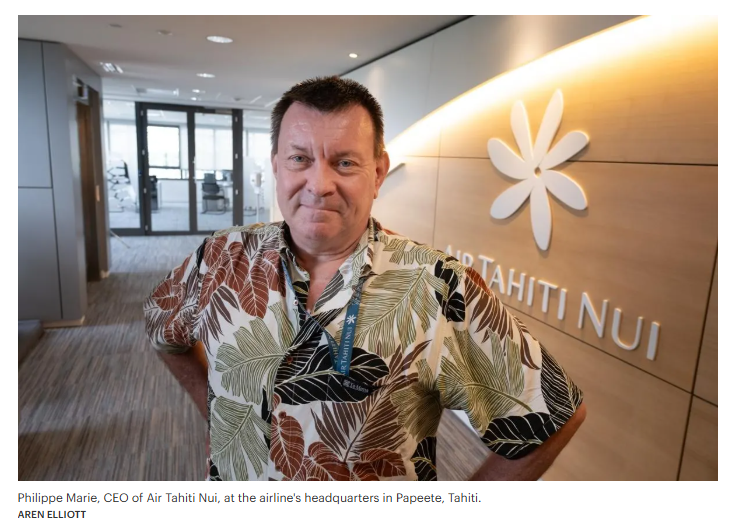
From Philippe Marie’s corner office in Papeete, you can see most of Air Tahiti Nui’s fleet of four Boeing 787s at any given time.
One cobalt Dreamliner parked at the terminal is bound for Los Angeles tomorrow. The other, New Zealand.
Marie, the CEO of Air Tahiti Nui, calls the planes his blue birds. They connect Tahiti to the mainland, serving Los Angeles, Seattle, Tokyo and Auckland.
But these long-haul aircraft are also, improbably, agents of change.
The French Polynesian government created Air Tahiti Nui in 1996 to control the region’s economic and tourism destiny. Marie says before that, the islands were dependent on foreign carriers and market forces, which often left Tahitians stranded on their own island.
But this dependency means that survival and environmental protection are connected for the airline. Sustainability isn’t optional; it’s mandatory for a destination like Tahiti because it’s small, remote, and isolated.
So for Air Tahiti Nui, whose majority shareholder is the Tahitian government, the goal is obvious: to ensure sustainable operations that support the development of the tourism industry and the preservation of the island’s environment.
Practically speaking, that means punching above its weight. Air Tahiti Nui’s sustainability strategy, formalized a decade ago, rests on technology, engagement and leveraging a relationship with the Tahitian government. It’s also making its mark as a reliable and culturally rich airline for visitors to French Polynesia.
How the blue birds are making Tahiti sustainable
The first step toward creating a more sustainable airline was complete fleet renewal in 2018. Air Tahiti Nui replaced its older Airbus models with four new Boeing 787-9 Dreamliners. Marie says they chose the 787s — planes you would expect to find at a major airline — for one main reason.
“They were the most efficient aircraft available at the time and offered a lower environmental impact.,” he says. “And they still are.”
This efficiency focus extends to daily operations, including advanced internal procedures to optimize fuel consumption, such as route adjustments and reduction of onboard weight. The focus on operational efficiency has resulted in an average fuel consumption rate that’s slightly better than the industry average.
The company also ensures its buildings are energy efficient, using solar panels and centralized air conditioning at its headquarters near Tahiti’s Faa’a Airport.
A passenger’s journey through the Green Corridor
The second sustainability driver is engagement, and this starts in the cabin. Air Tahiti Nui has created a continuous green corridor that spans the entire customer experience.
For the average passenger, the most visible change is the obsessive war on waste. The airline has removed virtually all single-use plastics from the cabins, a process that took two years and required extensive cooperation from its suppliers.
The airline swapped out these plastics with environmentally friendly materials, such as bamboo and vegetable fibers, as well as recycled cardboard and plastics. To do that, the airline had to reverse the common industry practice of wrapping everything in plastic. Its business class amenity kit — featuring eco-friendly items like a wood toothbrush, bamboo fiber socks, and organic cotton eye mask — received a sustainability award from the World Catering Expo.
The airline also revised its catering supply chain, focusing its efforts on locally produced items.
“That means that when departing from Tahiti, we prioritize local fruit, vegetables, and meat for the catering,” says Marie. “This not only cuts down on unnecessary imports but also helps boost local agriculture and businesses.”
Empowering travelers through carbon offsetting
Marie says Air Tahiti Nui understands that operational changes alone aren’t enough. Since 2021, the company has also offered a voluntary carbon offset program in partnership with CarbonClick, allowing travelers to counter the CO₂ emissions generated by their flights in a meaningful way. Travelers can choose to contribute anywhere from 50 to 200 percent of their calculated flight emissions.
The commitment to the environment extends to local conservation projects. For example, it recently launched a program that allows travelers to contribute directly to the preservation of Tahiti’s monarch birds, an endemic and highly endangered species, managed by the Manu Association. The project, which focuses on habitat restoration, plays a crucial role in protecting unique and threatened biodiversity in Tahiti.
Tapping into Tahiti’s circular economy
Of course, there’s also recycling. Any self-respecting sustainability program has it, and Air Tahiti Nui’s goes far beyond simple waste separation, according to Marie. Air Tahiti Nui views old materials not as waste, but as raw materials, creating visible upcycling programs.
When the airline changed its crew uniforms, it didn’t just discard them. The airline donated the uniforms to a local school for disadvantaged kids. These students repurposed the uniforms to create handbags and shirts, which they sell to raise money for school supplies. In a smaller but impactful change, used crew dresses were cut and sewn into large bags for the cleaning crew, and then used instead of disposable plastic bags.
The airline also had a surplus of used glasses with the Air Tahiti Nui logo. Instead of throwing them away, the company partnered with a local company that makes scented candles using Tahitian tiaré flowers. The company fills the used glasses with wax, upcycling the material into a new product that is sold locally.
It’s unusual to find an airline with such a well-developed sustainability program, let alone an airline of Air Tahiti Nui’s size. But Marie says there’s more work to be done.
Still a long way to go to become sustainable
Air Tahiti Nui’s size and geographic location intensify the challenges of implementing widespread sustainable initiatives.
For instance, implementing Sustainable Aviation Fuel (SAF) remains a massive obstacle. Marie explained that because the airline is a small player, it lacks the purchasing power to compete with huge airlines for SAF supplies, which themselves face supply chain challenges.
Instead, the company relies heavily on the French Polynesian government, which drives the energy policy, to act as its advocate. Marie says the government works with major fuel suppliers like Total and Shell to ensure the fuel delivered to Tahiti is already pre-mixed with SAF. It’s just another way a small airline can do things only a big carrier would.
“This strategy ensures we meet our compliance obligations,” he says.
Marie’s vision is that governments should encourage airlines to invest in new technologies and allow the carriers to retain capital to drive technological evolution necessary for sustainable flying. He feels that trust should be placed in the airlines, who are driving their own sustainability programs.
An end to air travel?
Reality check: Modern aviation punches a hole in the ozone layer and leaves a massive carbon footprint. So is the ultimate goal to end air travel as we know it?
“No,” says Marie. “The challenge lies in managing tourism responsibly.”
Marie’s long-term vision is centered on slow tourism — getting people to the island and keeping them there for a while. Preserving the beauty of the islands means carefully managing growth and infrastructure development.
“We have to make sure our fleet capacity and network expansion match our sustainability plans,” he adds.
Marie says when people meet, it fosters understanding and connection. The company is already looking toward technological advancements, such as anticipating the development of hydrogen fuel or electric engines for aircraft.
Outside of Marie’s office, a light tropical rain has started to fall. Perhaps it’s a fitting metaphor for the journey itself, which is not always sunshine and smooth landings.
“It may be raining outside,” he says. “But our planes are always blue.”
Marie says the ultimate mission of Air Tahiti Nui is to share the beauty of the South Pacific.
“We want to make sure our islands stay beautiful for a long time,” he adds.
Article Credit: forbes