
Industrial Design alumni founded Ecoforma and share an approach to sustainable electronics. Practice aligns with ID education and helps students act on pressing challenges today.
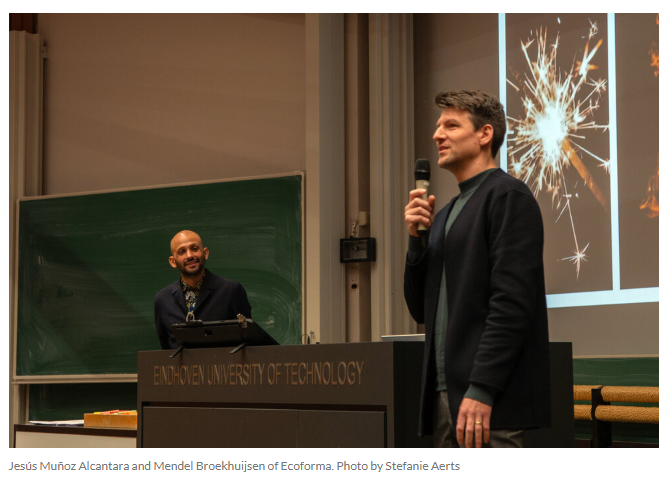
Recently, alumni Mendel Broekhuijsen and Jesús Muñoz Alcantara spoke with students in the Sustainability and Design course at TUe about how their studio, Ecoforma, helps designers of electronic products apply sustainable strategies. It was a good opportunity to show how Industrial Design prepares the next generation for this societal challenge and how alumni expertise flows back into education.
Knowledge in action
Ecoforma develops tools and training that help designers understand where sustainable choices are possible in the design of electronic products. Broekhuijsen and Muñoz are currently asked most often to teach the basic principles of ecodesign and to get teams moving. After years of talking about future proof design they decided to take it seriously, wrote a business plan and registered the initiative at the Chamber of Commerce to dedicate time and attention.
Design for impact
Electronics are essential in daily life, yet they raise questions about material use, energy use, product life and waste streams. Design can connect technology, use and system impact. For Industrial Design this is relevant because our designers shape products as well as processes, services and behavior around those products. The role of the designer becomes visible when addressing sustainability in electronic products.
Tough choices
Society asks for products that last longer, are easier to repair and keep value after use. Scarce materials, growing e waste and changing regulations require choices made in exploration and early concept. Many organizations face barriers from uncertainty about supply chains to the idea that choices fall outside their influence. According to Broekhuijsen and Muñoz this is where design research (research-through-design is needed to explore and connect opportunities.
Studio as lab
At Industrial Design, students follow courses on sustainability that are tailored to designers. They don’t just work on electronic products with attention to life cycle thinking, circular strategies, and linking design decisions to viable business models. They also explore broader views on sustainability aligned with planetary justice. The guest lecture by Ecoforma aligned with this and showed how methods from practice can be applied directly in project education and studio assignments.
Behavior in focus
A recent example is a project funded by the European Union within the energy transition. Ecoforma is designing a product for the home that helps residents understand their energy use and behavior. The focus is on sustainable behavior, which means the product itself must also be designed with sustainability at its core. Impact on behavior and responsible material and production choices come together in one design brief.
Aricle on LED design
Storytelling and research proved immediately valuable at the start of the agency. A clear story makes the value understandable for everyone, and research offers direction and credibility. Broekhuijsen and Muñoz note that their first article on justice-led-design helped in the dialogue with academic partners. What they took from their studies is switching between disciplines and languages, from the details engineers bring to the bigger picture of value and meaning.
Choice is possible
A common misunderstanding is that companies have no choice and that designers have no influence on electronic components because they are ordered as fixed sets from abroad. Broekhuijsen and Muñoz emphasize that designers do have influence and responsibility, especially when specifying, combining and positioning components and shaping function, use maintenance and end of life.
Frameworks that help
Ecoforma uses and adapts existing frameworks such as those from CIRCO, the Ellen MacArthur Foundation and the Circular Compass. These structures make design choices discussable in every phase of the process and link them to sustainable business models. In their workshops they translate theory on circularity into hands-on canvases and formats that work for commercial product development teams.
Mark the moment
To students they suggest building a company around a topic you care about deeply, because starting requires persistence, learning and sometimes steering toward a new path. With a smile, register your company during Dutch Design Week, World E waste Day or another annual moment that matches your mission. You will have a podium each year to share your story.
Article Credit: tue