
For most of her life, Florence Ntisai lived in the shadows of her community, silenced by stigma and excluded from conversations that shaped her future. Born with phocomelia, a congenital condition that left her with underdeveloped arms, she grew up in Samburu County, one of Kenya’s arid regions, where traditional beliefs and lack of awareness meant women with disabilities were often hidden from public life.
“I couldn’t even stand up to introduce myself,” she recalled.

Today, Florence stands at the forefront of climate advocacy in her community, leading an organisation that has empowered dozens of women with disabilities to claim their voices in climate governance.
Florence’s journey changed in 2024 when she joined the Strengthening the Voices of Women with Disabilities to Actively Participate in Climate Change Policy and Negotiations (STREVOW), a groundbreaking initiative designed to amplify the voices of women like her.
Funded by the Africa Climate Change Fund (ACCF), STREVOW is a three-year initiative across 12 East African countries and Small Island Developing States. Its goal is to shift women with disabilities from being overlooked victims of climate impacts to recognised actors shaping climate solutions.
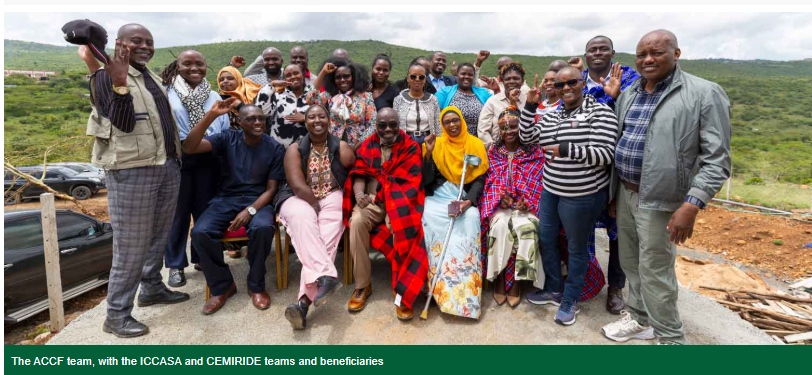
The project, implemented by Inclusive Climate Change Adaptation for a Sustainable Africa and the Centre for Minority Rights Development, equips women with disabilities with the knowledge, confidence, and networks to raise their voices in spaces where they have been excluded. Through it, Florence was trained on climate change policy, advocacy, and public speaking, alongside peer mentorship and leadership development.
“I have gained confidence,” she said. “Now I use what I learned to advocate for my rights and those of others.”
Inspired by her newfound skills and confidence, Florence founded the Kimunyak Differently Abled Initiative (KDAI), a community-based organisation that promotes inclusive climate action and sustainable livelihoods in Samburu, a region plagued by prolonged droughts and flash floods.
KDAI has so far supported 53 women with disabilities, including adolescent girls, young mothers, and caregivers, to engage in local climate dialogues and push for policies that reflect their unique needs and experiences.
STREVOW’s Push for Inclusive Climate Change Dialogues

Halima Shariff, Founder of Women of Hope Abled Differently (WHAD), and Florence Ntisai, during a discussion with project beneficiaries as part of the ACCF supervision mission.
Florence’s story is not unique. Halima Shariff, Founder of Women of Hope Abled Differently (WHAD), has experienced a similar transformation. “The STREVOW trainings have built my capacity on climate change negotiations and policy,” Shariff said. “It also gave me courage to speak out as an indigenous and minority woman.”
At an April 2025 regional review, stakeholders highlighted early achievements that suggest the project is delivering on its ambitious goals. Participants reported improved understanding of gender and disability dimensions in climate policy, stronger capacity for women with disabilities to influence negotiations, and participation in multiple decision-making forums.
The project has established a regional platform to mainstream the perspectives of women with disabilities in climate governance structures across East Africa. The initiative has also opened doors at the international level, enabling women with disabilities to attend and contribute meaningfully to United Nations-led global climate change negotiations, a milestone in breaking down longstanding barriers to participation.
Rita Effah, Senior Climate Finance Officer at the African Development Bank and ACCF Coordinator, underscored the urgency of integrating women with disabilities in local decision-making during a recent project supervision mission. “When it comes to the impact of climate change and extreme weather events, persons with disabilities are among the most vulnerable in our communities; but often their voices are absent from climate change policy discussions — a disservice to this vital constituency,” Effah said. “That is why this project STREVOW is very important.”
Article Credit: afdb