
London and Beijing’s success in curbing vehicular emissions shows why India must look beyond cleaner vehicle technology to sustained enforcement, better public transport and coordinated urban planning
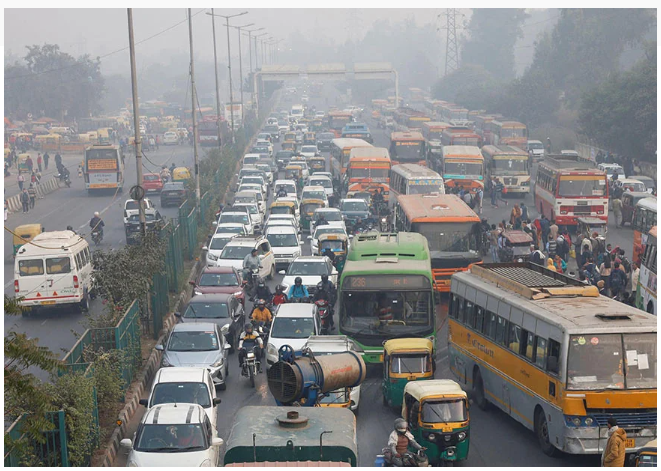
The idea that emissions from everyday cooking in cities could exceed those from vehicle exhaust pipes might sound fanciful. However, researchers have found that in parts of London and Beijing, this is what happens. A recent study comparing emissions in London, Beijing and Delhi reveals that everyday cooking generates more directly emitted non-refractory fine particulate matter smaller than one micrometre (PM1) in certain neighbourhoods in the British and Chinese capitals. In contrast, Delhi’s emissions continue to be dominated by traffic and other combustion activities.
The findings highlight the success of emission controls, improved vehicle technology and sustained regulatory intervention in London and Beijing. However, despite progressively tighter emission standards and the push for electric vehicles (EVs) and ethanol-blended petrol, India continues to grapple with vehicular pollution. What have London and Beijing done differently, and what can Indian cities learn from their experience?
When Cooking Becomes the Bigger Polluter
An international research team led by the UK Centre for Ecology & Hydrology (UKCEH) used sophisticated atmospheric instruments to measure emissions from cooking, traffic and other air-pollution sources in certain neighbourhoods across the three megacities, with remarkable results. Cooking accounted for up to 83 percent of primary PM1 emissions at midday in London and 87 percent in the early evening. In Beijing, the corresponding figures were 61 and 76 percent. Traffic exhausts made up less than 10 percent of the measured primary emissions in both cities.
These measurements cover a specific category of directly emitted particles, rather than all pollutants or overall ambient air pollution. They also exclude particles from braking, tyre abrasion and road-surface friction. Even so, the findings show how sustained controls on vehicular emissions have transformed the composition of air pollution in these cities. Across the United Kingdom, fine particulate emissions from vehicle exhausts declined by 94 percent between 1996 and 2024.
The research highlights a relatively neglected pollution source. Commercial kitchens and food preparation, particularly frying, release substantial quantities of fine particles that most national and international pollution inventories do not account for.
The study also notes that much of the particulate matter in London and Beijing forms through atmospheric chemical reactions involving pollutants from multiple sources, including agricultural activities beyond city boundaries. This indicates that improving urban air quality requires more than reducing vehicular exhaust emissions.
London’s Road to Cleaner Transport
London’s Congestion Charge, introduced in 2003, sought to discourage unnecessary vehicle use in central London. Later policies focused more directly on reducing emissions from older, more polluting vehicles. The Ultra Low Emission Zone (ULEZ), introduced in 2019 and expanded to cover all London boroughs in August 2023, imposes a charge on vehicles that fail to meet prescribed emission standards while being driven within the zone.
London’s experience suggests that emission standards are more effective when paired with measures that discourage the use of highly polluting vehicles.
According to the Greater London Authority’s 2025 assessment, roadside nitrogen dioxide concentrations in 2024 were estimated to be 27 percent lower across London, and 54 percent lower in central London, than they would have been without the ULEZ. The assessment also estimated that fine particulate matter (PM2.5) emissions from cars and vans in outer London were 31 percent lower than they would have been without the ULEZ expansion.
London’s experience suggests that emission standards are more effective when paired with measures that discourage the use of highly polluting vehicles.
Beijing’s Comprehensive Approach
Once associated with severe air pollution, China’s capital has achieved substantial improvements through sustained interventions across transport, industry and energy. Beginning in the late 1990s, Beijing progressively tightened vehicle emission standards, promoted the retirement of older, polluting vehicles and expanded public transport. Parallel improvements in fuel quality and investment in cleaner transport supported these measures.
A United Nations Environment Programme assessment estimated that vehicle emission-control policies implemented between 1998 and 2013 reduced vehicular carbon monoxide by 76 percent, nitrogen oxides by 40 percent and PM2.5 emissions by 70 percent. Beijing’s wider air-quality gains have been equally marked.
Once associated with severe air pollution, China’s capital has achieved substantial improvements through sustained interventions across transport, industry and energy.
Beijing simultaneously tackled coal combustion, industrial emissions and pollution from surrounding areas under its coordinated pollution-control programme. According to official environmental data, annual average PM2.5 concentrations fell from 89.5 micrograms per cubic metre in 2013 to 30.5 micrograms per cubic metre in 2024, a 65.9 percent reduction.
India’s Continuing Struggle
India has formulated important policies, including the implementation of Bharat Stage VI emission standards in April 2020, which substantially restricted permissible emissions from new vehicles. Government programmes have encouraged electric mobility, with several cities replacing conventional bus fleets with electric buses. Ethanol blending has also become a key component of the country’s fuel strategy. However, these measures address different aspects of vehicular pollution separately.
EVs eliminate tailpipe emissions but not particulate emissions from tyres, braking and road dust. Replacing conventional cars with electric ones does not address traffic congestion, parking demand and the growing competition for road space.
The ethanol-blending programme has limitations. NITI Aayog’s roadmap recorded reductions in carbon monoxide and hydrocarbon emissions in tests using E20 fuel, but showed mixed results for nitrogen oxides and an increase in emissions of certain carbonyl compounds. Moreover, rapidly expanding vehicle fleets, ageing commercial vehicles, congestion and inconsistent emission-compliance monitoring frequently undermine improvements from cleaner technology.
India’s National Clean Air Programme has also made limited progress. While 108 of the 130 participating cities reported reductions in annual particulate matter (PM10) concentrations during 2025-26 compared with 2017-18, only 14 cities met the prescribed annual national ambient PM10 standard. Although these figures cover overall particulate pollution, they illustrate the gap in achieving acceptable air quality.
Institutional fragmentation further complicates the challenge. Different agencies handle urban transport, traffic regulation, vehicle registration, pollution monitoring and road management. Municipal governments have limited authority over most of these activities that directly affect air quality. Consequently, initiatives to reduce vehicular pollution lie outside the scope of municipal transport planning and urban development.
Lessons for Indian Cities
The different regulatory and administrative approaches pursued by London and Beijing do not provide a replicable model for India. However, their experience offers several practical lessons.
First, emission compliance must extend throughout a vehicle’s operating life. Stricter standards for new vehicles achieve limited results if older vehicles remain poorly maintained. India’s widely criticised pollution-under-control (PUC) certification system needs more reliable testing, independent verification and regular on-road inspections, particularly for commercial and diesel vehicles.
The different regulatory and administrative approaches pursued by London and Beijing do not provide a replicable model for India. However, their experience offers several practical lessons.
Second, India must consider low-emission zones, beginning with the most congested and polluted urban areas. It must identify congested commercial districts and major transport corridors where restrictions on polluting vehicles can be introduced in phases. Such measures would require affordable public transport alternatives, transparent enforcement and safeguards for lower-income users and small businesses.
Third, vehicles with high daily utilisation must be prioritised. Electrifying buses, taxis, autorickshaws, delivery vehicles and freight fleets could deliver considerable benefits because of their extensive daily operations. Urban freight and logistics, frequently overlooked in mobility planning, must become integral to clean-air strategies.
Fourth, cleaner vehicles must be accompanied by better mobility planning. Reliable public transport, walking and cycling infrastructure, parking regulation and improved traffic management are essential to reducing dependence on private vehicles. The objective should be to reduce polluting vehicle-kilometres, rather than merely replace conventional vehicles with electric alternatives.
Equally important is an institutional framework that can coordinate transport, environmental regulation and urban planning across municipal boundaries.
Beyond Cleaner Vehicles
The London-Beijing comparison implies neither that cooking must become India’s next major pollution-control target nor that these two cities have achieved zero vehicular pollution. Rather, it demonstrates what sustained enforcement of emission controls can achieve. For India, the priority remains reducing emissions from traffic and combustion while addressing other contributors to worsening urban air quality. While EVs, ethanol blending and tighter emission standards are necessary parts of this effort, cleaner technology cannot substitute for effective enforcement, better public transport, traffic management and coordinated metropolitan governance.
The London-Beijing comparison implies neither that cooking must become India’s next major pollution-control target nor that these two cities have achieved zero vehicular pollution. Rather, it demonstrates what sustained enforcement of emission controls can achieve.
With Delhi and several other cities across northern India continuing to experience dangerously high pollution levels, particularly during winter, the urgency of moving beyond piecemeal interventions towards sustained, coordinated action has never been greater. London and Beijing have shown that large reductions in vehicular emissions are possible. India must now look beyond cleaner vehicles to a more comprehensive approach to urban mobility and pollution control. Until then, the prospect of cooking emissions overtaking vehicular exhaust emissions will remain fanciful for Indian cities.
SLSV Analysis and Insights
- Success reveals the next frontier: In London, cooking accounted for up to 83% of primary PM1 at midday and 87% in the early evening, and in Beijing 61% and 76% respectively, while traffic exhaust was under 10% — a sign that sustained vehicle controls work.
- Regulation, not technology alone: UK fine particulate emissions from vehicle exhaust fell 94% between 1996 and 2024, driven by Euro standards, London’s congestion charge and Ultra Low Emission Zone, and enforcement.
- The inventory gap is global: Commercial kitchens, especially frying, were largely excluded from national inventories. London only recently added cooking to its Atmospheric Emission Inventory.
- Emerging trend — from tailpipe to whole-system: Best practice is shifting to flux-based monitoring, source apportionment, and non-exhaust particles from brakes, tyres and roads, which EVs will not solve.
- India is at a different stage: In Delhi, traffic and combustion still dominate. Cooking is only 8% of daily direct PM1, though absolute output is comparable to London’s. India must not copy London’s next target before finishing its first one.
- Future trend — filtration as low-hanging fruit: High-efficiency kitchen filtration, electrostatic precipitators and grease traps are emerging as quick, cost-effective interventions in the UK, EU, China and Singapore. 8b88
SLSV Recommends
SLSV recommends India prioritise a two-track strategy: first, accelerate BS-VI enforcement, EV adoption, public transport and non-exhaust controls to replicate London and Beijing’s tailpipe success, and second, proactively build cooking-emission inventories, mandate filtration standards for commercial kitchens in dense food hubs, and pilot tower-based monitoring in Delhi, Mumbai and Bengaluru — so India can prevent cooking from becoming its next unregulated crisis while it still cleans up traffic.
Article Credit: orfonline, SLSVoriginal source/SLSV