
Dear EarthTalk: Have there been any innovations in air conditioning technology in recent years to help mitigate climate impacts of staying cool?
—Jason Wilcox, via email
As global temperatures have risen and extreme heatwaves have become more frequent, the demand for air conditioning has surged dramatically. Staying cool is a critical health necessity, but it is a major resource challenge. Conventional cooling systems consume massive amounts of electricity, strain power grids, and release powerful heat-trapping gases into the atmosphere, creating a complex environmental dilemma.
Traditional cooling units have effectively trapped society in a compounding environmental problem. As outdoor temperatures climb, people turn up their air conditioning, which spikes energy demand and increases fossil fuel emissions, ultimately driving further global warming. As Nicole Miranda, an engineer researching sustainable cooling at the University of Oxford, notes regarding this feedback loop, “We’re in a vicious cycle,” and “it’s not only a vicious cycle, but it’s an accelerating one.”
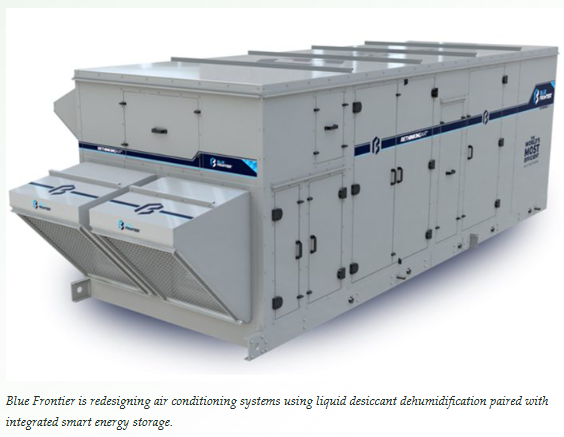
To break this loop, climate innovators are developing next-generation technologies that rely on completely different principles. Emerging companies like Blue Frontier are redesigning systems using liquid desiccant dehumidification paired with integrated smart energy storage. These advanced systems store cooling capacity and dramatically reduce grid stress during peak heat periods. Dr. Daniel Betts, CEO of Blue Frontier, states, “We’re looking at 50 to 90 percent reductions in energy consumption.”
Academic and research institutions are pioneering low-carbon-footprint solutions that sidestep traditional vapor compression constraints entirely. Developers at Harvard’s Wyss Institute have advanced innovative evaporative cooling configurations, known as cSNAP systems, designed to cool air without adding indoor humidity. Their technology employs a “specialized coating [that] isolates incoming hot air from outgoing wet air, allowing the hot air to be cooled by circulating water without adding humidity to the inside of the building.” By using nanoscale surface treatments on materials like 3D-printed ceramic, these low-power heat exchangers deliver efficient thermal comfort while significantly reducing environmental footprints.
Researchers are also looking at physics-based solutions whereby specialized surfaces reflect solar radiation and emit thermal energy straight out into cold outer space. Urban planners are integrating AI-driven automated systems to lower microclimate temperatures and shield interiors from solar gain. By combining passive design with ultra-efficient mechanical cooling, cities can successfully mitigate the climate impacts of staying cool.
Article Credit: emagazine