
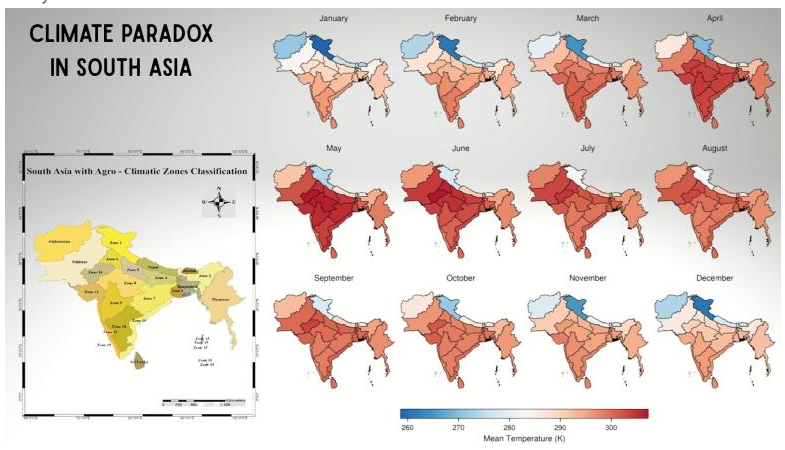
Researchers from the Indian Institute of Technology (IIT) Kharagpur have found highly erratic and localised temperature shifts across South Asia, revealing that the region is heavily deviating from typical global warming patterns. By analysing high-resolution climate data spanning over two decades, researchers Ishita Sharan Srivastava and Aditya Kumar Patra found that high-altitude mountainous areas are warming at an alarming rate, while some inland plains are actually experiencing unexpected cooling during certain months. This complex climatic interplay, which impacts the lives and livelihoods of a quarter of the world’s population, highlights how geographical diversity significantly alters the effects of climate change.
The researchers examined temperature patterns from 2001 to 2023 across fifteen distinct agro-climatic zones in South Asia, covering eight nations, including India, Afghanistan, Nepal, and Sri Lanka. They utilised the ERA5 dataset provided by the European Centre for Medium-Range Weather Forecasts. This system blends satellite data, historical observations, and computer modelling to provide incredibly detailed, hourly temperature records. The researchers compared these monthly temperature averages against a twenty-year baseline to calculate anomalies, or unusual deviations from normal weather patterns. The standardisation allowed them to probe where and when abnormal warming or cooling was happening across the continent.
The findings show that the regions are sharply divided by their geography and atmosphere. High-altitude regions, such as the Himalayas in Nepal and the mountains of Afghanistan, are experiencing intense, rapid warming, particularly in the months leading up to the summer and winter. This is largely driven by a feedback loop, where as global temperatures rise, mountain snow melts. Because pristine white snow reflects the sun’s heat into space, losing this snow cover exposes darker land and rocks, which instead absorb the heat, causing the area to warm even faster. This process is worsened by light-absorbing aerosols like black carbon, a type of dark soot from human pollution, which settles on the ice, reduces reflectivity, and accelerates the melting.
Conversely, coastal and island areas like Sri Lanka have remained much more stable. These regions are protected by the moderating influence of the surrounding oceans, which have high thermal inertia, meaning they absorb and slowly release heat, keeping local temperatures relatively steady.
Surprisingly, the researchers also discovered distinct cooling trends during May and December in specific areas, such as Pakistan and India’s eastern plateaus. This localised cooling is linked to short-term shifts in atmospheric circulation and changes in how land and sea temperatures interact. Furthermore, the massive South Asian monsoon system plays a critical role in controlling regional temperatures. During the rainy season, heavy clouds and rainfall cool the land, making temperatures much more predictable. However, when the monsoon retreats in September, the study found a sharp spike in warming across the continent, largely due to a lack of cloud cover letting intense solar radiation scorch the ground.
Human-made pollution adds yet another layer of complexity to this changing climate. While black carbon heats the atmosphere, other pollutants like sulfate aerosols can actually reflect sunlight and cause localised surface cooling. This dynamic interplay between greenhouse gases and different types of aerosols generates a distinct north-to-south gradient in how the region responds to climate change.
This research provides vital details of how local landscapes like elevation, land-use changes, and monsoon dynamics shape South Asia’s climate and weather. However, the researchers note that more research is needed to fully elucidate the complex interplay between natural weather oscillations and human-made air pollution.
Nonetheless, by providing a detailed map of exactly which regions are most vulnerable to extreme temperature fluctuations, this research offers a critical tool for governmentsto design targeted climate adaptation strategies. From building high-altitude observation networks to implementing early-warning systems for heat and drought, these insights will help protect vulnerable communities, secure food and water resources, and build a more resilient society against the escalating impacts of global climate change.
Article Credit: researchmatters